
Digital payments provider PhonePe has filed draft papers with markets regulator Sebi for its upcoming initial public offering (IPO) using the confidential pre-filing route. On Wednesday, the company's spokesperson said, "PhonePe Ltd has filed the Pre-filed Draft Red Herring Prospectus with Sebi and the stock exchanges, under...the Sebi ICDR Regulations in relation to the proposed initial public offering of its equity shares on the main board of the stock exchanges".
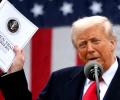
'You can't have a one-sided deal. If you have a lopsided deal then it won't be sustainable.'
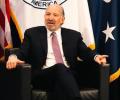
"So I think what happens is it's all bravado, because you think it feels good to fight with the biggest client in the world, but eventually your businesses are going to say you've got to stop this and go make a deal with America."

China accounts for about 70 per cent of global rare earth mining and nearly 90 per cent of rare earth magnet production, making it a dominant player and giving it significant leverage in global supply chains.

The Bihar government will provide a monthly allowance of Rs 1,000 to unemployed graduate youths for two years under the 'Mukhyamantri Nishchay Swayam Sahayta Bhatta Yojana'. This scheme has been expanded from intermediate-passed youth to include graduates.

'Even if tariffs are reduced, non-tariff may still remain a challenge.'

The Karnataka high court stayed enforcement of the Karnataka Cinemas (Regulation) (Amendment) Rules, 2025, which fixed a cap for movie ticket prices at Rs 200 across the state.
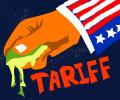
United States President Donald Trump on Friday announced that his administration will impose a 100 per cent tariff on branded and patented pharmaceutical products beginning October 1, 2025, unless the manufacturing companies are building production facilities in the US.
The Karnataka High Court has stayed the enforcement of a rule that capped movie ticket prices at Rs 200 across the state, following a petition by the Multiplex Association of India and other cinema stakeholders.

The Kerala High Court was informed that Arundhati Roy's book 'Mother Mary Come to Me' has a disclaimer against smoking on the back of its cover, in response to a plea seeking to prohibit the book's sale due to the author being shown smoking on the cover.

Ruling that Flipkart cannot "escape liability" as "mere intermediary" in an online purchase, a consumer commission here has found the e-commerce platform and television manufacturing company Thomson guilty of deficiency in service after a defective TV was delivered to a customer.

The Supreme Court has permitted the sale and bursting of green crackers in Delhi-NCR for Diwali, relaxing the ban on green firecrackers as a temporary measure from October 18 to 21. The court has asked pollution control boards to monitor pollution levels and file reports. The order also includes measures to prevent the sale of non-compliant crackers.

Amid controversy over USPresident Donald Trump's comments linking the use of Tylenol and other related paracetamol products by pregnant women to autism in children, experts and industry executives say that since India's export of the drug to the US is less, it will hardly affect the country's pharma exports to America.

'You are a guest in the US. It's not your home, you're a guest. If they don't feel comfortable, you have to step out.'
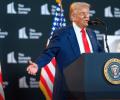
Trump said California has been particularly "hard hit" because of this, blaming democrat Gavin Newsom, the Governor of California, for this loss, calling him "weak and incompetent."

The Supreme Court is considering relaxing the ban on firecrackers in Delhi-NCR ahead of Diwali, citing practical concerns and the need to balance environmental and livelihood interests.
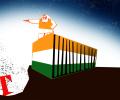
'When negotiators meet next, they may like to bring new issues to the table.'

The US Citizenship and Immigration Services (USCIS) in a 'H-1B FAQ' document, released on Sunday, said that the September 19 proclamation took an "important, initial, and incremental step" to reform the H-1B visa programme to curb abuses and protect American workers.

The United States did not accept India's request for consultations under an agreement of the World Trade Organisation (WTO) concerning American tariffs on steel, aluminium, and related derivative products, Parliament was informed on Tuesday.

Since the first Reit listing in 2019, the sector has grown to a market capitalisation of about $18 billion as of August 2025, and is projected to cross $25 billion by 2030.

The decision to hike US H-1B visa application fee to $100,000, trade talks and the GST rate cut will be the key drivers for stock market movement this week, analysts said.

Officials said the government-to-government engagement between the two countries on all other issues remains normal, but conceded rough spots over trade that need ironing out.

Amazon India unveiled a dedicated marketplace section highlighting products with reduced tax burdens as the goods and services tax (GST) restructuring took effect on September 22, positioning the ecommerce giant to capitalise on lower consumer prices across electronics, appliances, and other categories. Its rival Flipkart, too, has rolled out its own GST-focused storefront, the GST Bachat Utsav, aimed at helping shoppers maximise benefits from the new tax rates across multiple categories.

The Enforcement Directorate (ED) has frozen Rs 110 crore and seized 1,200 mule credit cards following searches against the Indian operations of Parimatch, a Cyprus-based online betting platform, for alleged money laundering and cheating investors.

'Khadi is versatile, breathable and timeless. What's missing is consistent innovation and branding. 'If khadi is positioned as both cool and conscious, it can easily sit between denim's everyday appeal and today's comfort-driven trends,' says Designer Swatti Kapoor.

Commerce and Industry Minister Piyush Goyal will accompany Prime Minister Narendra Modi to London for the signing of the free trade agreement between India and the UK on July 24, an official said on Monday. The two countries announced the conclusion of the negotiations for the trade agreement on May 6.

Senior officials from India and the US engaged in virtual talks to discuss bilateral ties, focusing on trade, investment, critical minerals, and energy security, including civil nuclear cooperation.
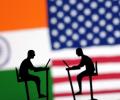
Commerce and Industry Minister Piyush Goyal on Tuesday expressed hope that India will conclude the proposed bilateral trade agreement (BTA) with the US by the fall or November this year. He said that "a little bit" of geopolitical issues overtook the trade matters in the negotiations for the pact between the two countries.
Trump administration's chief negotiator Brendan Lynch is arriving in India to hold talks on the India-US bilateral trade deal, which were impacted after the US imposed 50 per cent import tariffs on Indian goods.
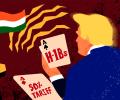
'This idea that inexpensive tech consultants should be coming into this country and bringing their families, I find it just wrong.'

The Enforcement Directorate has registered a FEMA case against Myntra and related entities for allegedly violating FDI guidelines, with contravention amounting to over Rs 1,654 crore.
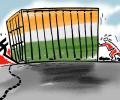
Merchandise exports to the US jumped 23.5 per cent year-on-year (Y-o-Y) to $8.3 billion in June, even as India's overall outbound shipments witnessed contraction during the month, according to the data released by the commerce department on Tuesday. The increase in outbound shipments to the US was largely driven by the rush among exporters to utilise America's pause on its plans to impose country-specific reciprocal tariffs.

'Kashmir has so many stories, cultures, and folklore. It should be promoted. We should definitely have more stories out of Kashmir.'

'Despite assurance from China, none of the companies have received supplies from Chinese sellers.'

Nepali students studying in India express anxiety and concern for their families back home amidst violent protests in Nepal, delaying travel plans and maintaining constant contact to ensure their safety.

'Our focus would be to onboard top 100 merchants in top 10 different segments.'
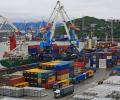
'There is definitely tepid demand because of the (reciprocal tariff) uncertainty.'

Yogesh Kathuniya won yet another silver medal in the men's F56 discus throw event at the World Para Athletics Championships.

Hiring activity has gained momentum in anticipation of upcoming festivals like Raksha Bandhan, Dussehra, Diwali, seasonal sales and the wedding season.

Union Commerce and Industry Minister Piyush Goyal on Thursday described the reduction in GST rates as "game-changing" and the "biggest reform" since independence, as he asked the industry to pass on the full benefit to consumers.
